Augmented Ecologies
Twenty metres down at Jessie Beazley Reef, Tubbataha — on reefs, attention, and what an augmented ecology might mean. Images © Andrea Marshall.
AUGMENTED ECOLOGIES
March 30 2023 @anselm - Images (c) Andrea Marshall
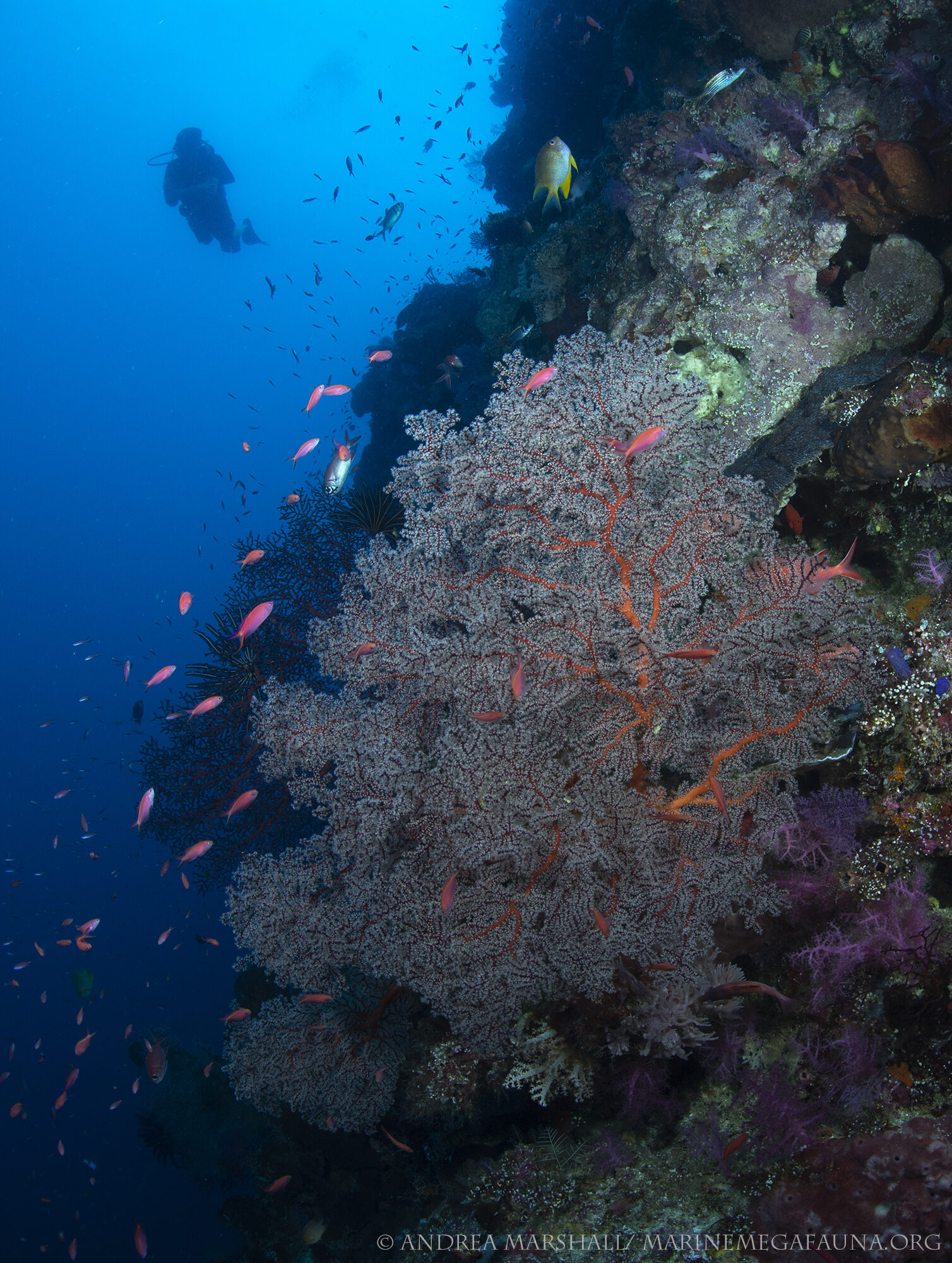
Jessie Beazley Reef Tubbataha March 2023
20 meters below sea level. A blue void to my left is a concourse of bright silvery fish diving downwards. Following their gaze to the murky depths I see the effortless flick of a whitetip reef shark cruising past. Looking to my right I face a vast colorful wall; a dizzying cacophony of color, light and motion, teeming with movement, colorful coral playing host to thousands of life forms of every size, shape, appearance, and behavior. Aside from my breathing, the water is filled with tiny clicks, crinkling and crackling sounds, groans and growls. A dizzying array of nature on fast forward, life under a microscope, at a density and velocity that in the truest sense defies categorization.
I breathe in. I breathe out. Purple and citrine coral sea fans larger than me project outwards in thin lacy sheets. Blue triggerfish with red teeth hide their little faces in crevices while leaving their little tail fin butts poking out, black ones with iridescent fins pick at coral, gold triggerfish with turing reaction-diffusion patterns fight over territory or unknowable outcomes, grey fish with large white spotted bellies regard you with one eye. Squadrons of yellowtail fusiliers flock past. Smaller flotillas of butterflyfish with horizontal chevrons collectively dart from one point of interest to another - past a yellow striped ribboned sweetlips nested under staghorn coral. A lone needle like cornetfish sails past. Timid wrasse curve and zip in and out. The whole reef suddenly reacts as a single organism to any motion.
The sound of bubbles trails behind me. Even the nearer volumes of water are alive. Almost invisible thumb sized ghostly and entirely translucent salps in chains gulp past, siphonophores comprised of cloned zooids each perform different roles, teeny tiny iridescent comb jellies drift past, and tiny squid ping pong around, a paper nautilus hangs onto a gelatinous zooplankton for a free ride, eel larvae ribbons curl up in spirals. At night during the diel migration this becomes an impossible carnival of glowing and highly reflective tiny organisms.
Reefs make you feel like you're inside a system. For some reason sea creatures interact more with humans. Domino damselfish are moving in precise unison, in an almost orchestral way, in and out of a colony coral, responding as a single body to your motion. Some kind of relationship is occuring; occasionally there is a match between the color and patterning of corals and their client species. Pygmy seahorse are almost indistinguishable from their seafan homes; even when pointed out. Clownfish families dart between the nematocysts on fat tentacles of a brightly colored anemone - often one larger aggressive elder mother clownfish emerging to challenge the diver. Giant black and red fire urchins are the underwater mobile art cars, trundling along sandy floors; glowing purple and orange lines can be seen on closer inspection, and they carry a retinue of cardinal fish. As the sea urchins got close to each other the cardinal fish occasionally jump over to the nearest neighbor.
Nature delivers a lesson. I'm slowly learning to appreciate that the world may be more complex than we can apprehend; beyond our cold calculus, our reductionism. On land we have available to us only a small fraction of what nature has to show us. Underwater nature is volumetric, three dimensional. We may have a conceit that life evolved onto land and is somehow therefore better; but this is belied by what I'm witness to underwater. Terrestrial life is just an unfolding of genetic possibilities, an origami of diversity from a pattern repository built, trialed and defined by the sea. Marine ecosystems did not figure strongly in the literary romantic mythopoetics of western thought. Humboldt and Darwin didn't see underwater worlds. These places are upside-down mountains that are almost impossible to fully explore - physically or intellectually. Perhaps we need to bring more senses to bear other than reason.
Marine Megafauna Foundation
Our vessel is the Atlantis Azores, a liveaboard sponsored by the Marine Megafauna Foundation and run by a fantastically efficient team of locals, divemasters, chefs and support staff. Fourteen of us dive together here for a week. Four times a day we dive. This means wrestling into neoprene and other dive gear, checking nitrox levels, charging camera batteries, being pumeled by waves as we crest over them in small zodiacs and then finally rolling backwards into the sea to be ferried along underwater by currents. This is punctuated by coffee, chocolate and occasional hot showers. Every night we are rocked to sleep in our small cabins. As we slumber the captain brings us to our next location. Vast swells tilt the horizon outside the hull and in our dreams we feel more than hear the deep vibration of the ship’s engines. Each morning we wake to the static of intercom music and the distant ringing of the bell - all signaling the first pre-breakfast dive.
See: https://marinemegafauna.org/news/diving-in-shark-heaven-tubbataha-reefs-in-the-philippines .
We're a motley crew, a regular Gilligan's Island of people ranging from all walks of life. A trip like this can have costs approaching 10k USD once everything is factored in, flights, gear, opportunity cost, the liveaboard itself, and the skills and knowledge required to even be here. Everybody is thrilled; highly invested to say the least. A married couple continues their love of the sea, a retired widow dives to explore the world, a pair of funders who are helping sponsor the whole venture, the MMF founders themselves are present (and as marine biologists and researchers they do presentations on protecting wildlife and the critical role megafauna play). Two friends are with me, one of whom worked at SpaceX, and the other has spent over a year underwater. It's a gift to be able to be here.
One evening we dry off after diving and make our way amidships to the salon. Simon, a member of the MMF team, is doing a presentation on whale sharks - a large pelagic filter feeder that shows up occasionally in Tubbataha. Many questions remain: "Where do whale sharks reproduce?” “What are the global whale shark populations?” and “Where are the females, especially the pregnant females and where are their spawning grounds?". In fact only a single pregnant whale shark has ever been found, with 304 pups.
See: https://diveadvisor.com/simonjpierce/media/pregnant-whale-shark-in-galapagos-15331 .
Luckily whale sharks, enigmatic as they are, can each be uniquely identified. Each one has a unique fingerprint in the form of spot pattern coloration on their upper body that can be detected using an algorithm that was invented by Portland based diver and software programmer Jason Holmberg. With help from a NASA employee Zaven Arzoumanian, they invented the Groth algorithm. It’s an example of how 3d reconstruction and tracking algorithms used in many disciplines can pluck out identifiable features and can help track the movement of these megafauna through their world.
See: https://www.worldwildlife.org/species/whale-shark and https://youtu.be/MifNRZaBEos and https://www.nasa.gov/offices/oct/home/tech_life_animals.html and https://www.researchgate.net/publication/229786360_An_astronomical_pattern-matching_algorithm_for_computer-aided_identification_of_whale_sharks_Rhincodon_typus .
Fishing fleets already aggressively take advantage of what data they have to harvest fish somewhat indiscriminately. But one can imagine a planetary community taking our best guess about what areas to protect. This has already started with establishing protected area boundaries around fixed area ecosystems (such as reefs) but needs to extend to protect high seas regions that move around or that only need to be protected during certain times. Breeding areas especially need to be protected. Animals can be more vulnerable when they are having babies and it makes sense to conserve certain sizes of organisms because they often make the most babies each season. The UN Convention on the Law of the Sea is the start of such agreements and hopefully will grow over time as we learn more about the behavior of our underwater relatives.
See: https://www.nature.com/articles/d41586-023-00757-z
Signature marine species such as whale sharks are a proxy for human impacts on natural systems as a whole. Megafauna help us relate our terrestrial understanding of nature with a marine perspective. Because we can see them, because they are large, because they are cute, because they are possibly endangered - we have empathy. The costs of changing our behavior to protect these creatures seems to be within the realm of possibility. But it is the reefs they frequent, and the reefs that we have the honor of exploring, that are even more vulnerable to human impacts.
Seeing Reefs
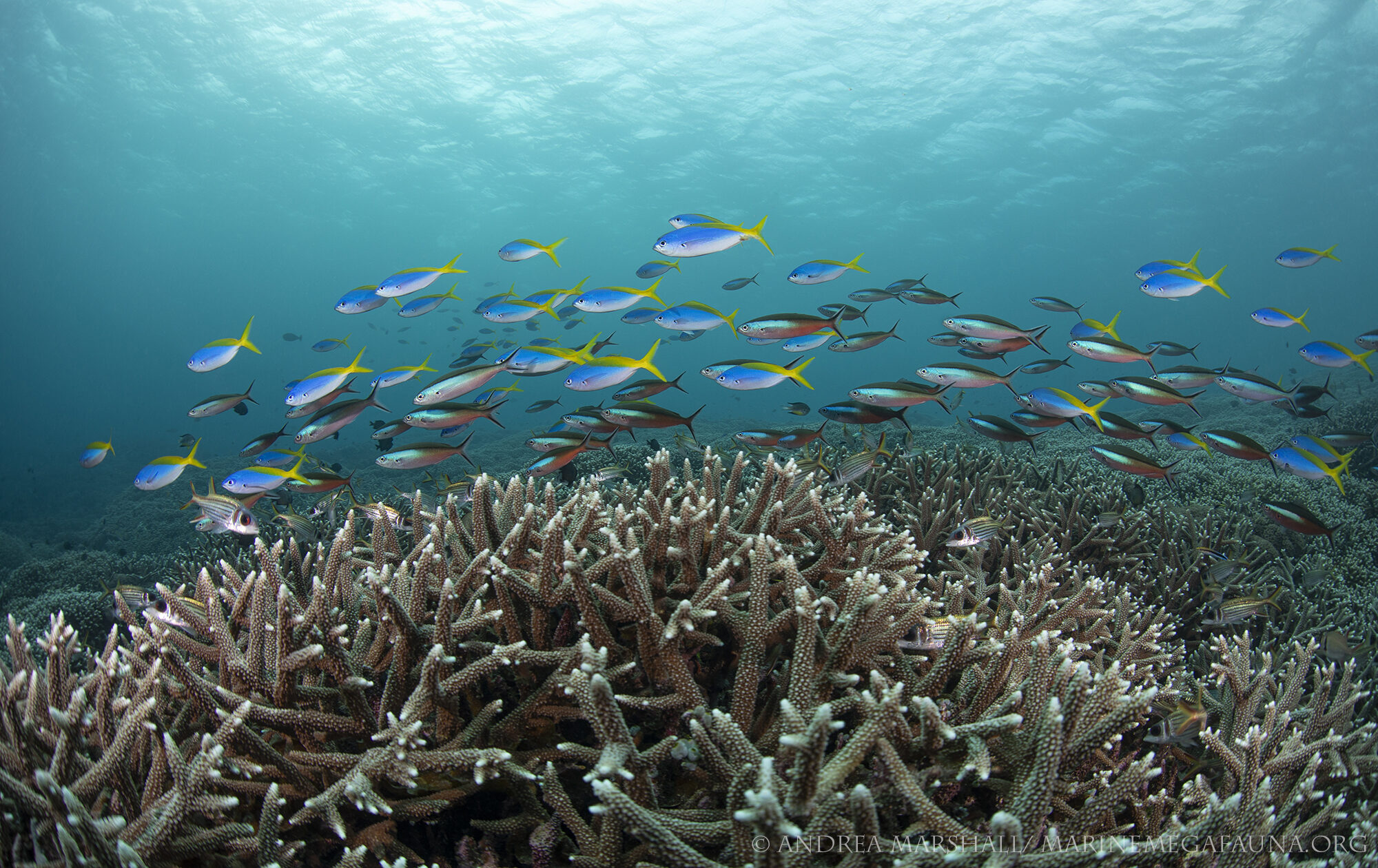
Coral reefs can be thought of as a meta-organism, a kind of city or arkology - in some ways very similar to human cities. We see not just the aggregate behavior of coral polyps and reef fish, but of an impossibly complex interaction of innumerable phenomena; a dance of life. Tides, weather, seasons, the blossoming and fading of plankton, the specific currents and how hot and cold water flows in our oceans, the movement of our freighters, saturation of dive spots by recreational divers, yearly or daily migratory routes, nursing grounds, and storehouses of genetic diversity.
If you're a terrestrial inhabitant, used to being on land, love hiking, nature - then it can be hard to fully "see" or appreciate corals. But reef ecosystems are captivating, once you see them you're essentially a convert to a new way of seeing everything else.
I strongly recommend watching "Chasing Coral", "Puff" and "BBC Blue Planet II" if you want to get a sense of what reefs are like, just how unique they are, and even how they may be even the best, and most important, example of what we need to protect here on earth.
See: Chasing Coral https://www.chasingcoral.com and Puff: Wonders of the Reef https://youtu.be/g-MdiE7gfmY and https://en.wikipedia.org/wiki/Blue_Planet_II .
Chasing Coral in particular makes the excellent point that although a two degree temperature rise may not feel like that much to us, imagine running a 2 degree fever constantly and how even that small temperature rise would feel.
Understanding Reefs: Burning down the house
What's surprising to me personally is that I didn't quite realize that we're potentially in the last few decades of these incredibly complex systems existing at all. We appear to be taking the genetic Library of Alexandria - a reserve of strategies, resilience, creativity that has arguably taken millions of years to accumulate - and burning it. There’s a way that people often have a naive optimism, or learned helplessness, that somebody else will do something, or that nothing can be done. Indeed if we simply extrapolate from our current behavior and look at the most typical scenarios outcomes do not look good.
In the West many of us are just starting to see reef ecosystems more clearly from a technical perspective. Work by early marine biologists such as Ed Ricketts in the 1930's and many others has helped resolve the texture of marine worlds in language we understand. There's a constellation of scientists who have dedicated their lives towards these topics.
We still don’t know exactly why some reefs do well and some do poorly. There are impacts from sunscreen, other pollutants, weather, anchors, pesticides, fertilizer run-off, acidity, salinity, explosive growths of predator species. Some reefs may be more adaptable to change due to deep water cooler upwellings, or a local reservoir of useful genetic diversity, or other unknown phenomena.
There appears to be a complex stack of relationships that are taking place that may in fact be beyond our comprehension. We seem to have a hubris around dominating natural systems, and we may need to trade in that view for a more synergistic relationship with nature. A recent article for example talks about how Antarctic meltwater is slowing deep ocean currents and that there may be secondary effects that are too large to stop.
We do know that corals are highly sensitive to warm water. In the same way that a two degree temperature rise in our own bodies can make us feel sick, corals will start bleaching if the temperature is raised for too long. When they bleach they die, their denizens also begin to die. A trophic cascade of diminished returns can have dramatic downstream impacts, impacting larger fish populations, human populations and even the impacts of storms on land.
Reef die-offs show us that humanity needs to find ways to comprehend, rally around and solve climate change. I want to be clear about this: the way that we talk about climate change or even global warming is inaccurate. It appears (to me) that given the scale of the problem, that we’re not going to solve the global warming crisis. We’re in a position today where we’re reliant on inventions that have yet to be created in order to continue life as we know it. We are the generation that has to fix this.
At the same time, actually diving in these reefs I do want to acknowledge that I am personally witnessing a natural resilience. I’m also being told that what's happening in reef ecosystems here in the Philippines isn't fully understood. Many of the reefs I've visited are in heavily trafficked regions of the Philippines. We pick plastic out of staghorn corals and off of sea fans. We see larger debris, anchors, barrels, the remains of ships. There's human effluent and oil sheens from freighters and boats. One of our destinations, Verde Island, is closed due to an oil spill at the time of our visit. There's significant human impact - yet these reef ecosystems are still vibrantly healthy. As I'm floating here I'm seeing a vitality that is far in excess of anything I've ever seen in my life. Their world may indeed be in crisis, but the reefs I’m diving in appear to be robust and I’m told they are resisting degradation. There does seem to be hope.
See: https://www.philstar.com/headlines/2023/03/21/2253241/oil-spill-reaches-verde-island and https://www.science.org/content/article/surprising-sign-resilience-some-corals-can-survive-long-heat-waves .
Returning
Wobbly but back on land. I'm in Manila. Surrounded by an incredible density of humanity. There are extremes here. The glazed windows of sky-scrapers only a few city blocks from tin shed shacks. Streams choked with garbage. Small children begging on the streets in the exhaust of car fumes. Shopping malls with their entrances guarded by machine guns. The mindless grind of menial labor. The well dressed housewives. There is brightness, ease, and joy, but there's also a tremendous waste of human potential.
Physically standing in a city I notice I'm sensitive to people, faces, gestures, clothing, traffic, signage. Then comparing and contrasting how that feels to be underwater looking at a reef ecosystem - I feel vividly that we are desensitized to Nature. What I mean by this is that if we lived in close relationship with Nature, relied on rain, and animals beyond our control, that we'd be hugely sensitive to the smaller ebbs and flows of different phenomena. I don't know what it would be like, but I imagine we'd have something more like an “indigenous” relationship or some kind of closer relationship, where the term is used to indicate better seeing land itself, based on a reliance on that land, where we'd possibly have more non-human friends than human friends. Not to say this is necessarily better or worse, but it feels different from the texture of reality I experience in the hive of a city - where nature is almost irrelevant, and certainly marginalized as an actor.
David Abrams speaks to this in “The Spell of the Sensuous”:
“Caught up in a mass of abstractions, our attention hypnotized by a host of human-made technologies that only reflect us back to ourselves, it is all too easy for us to forget our carnal inherence in a more-than-human matrix of sensations and sensibilities. Our bodies have formed themselves in delicate reciprocity with the manifold textures, sounds, and shapes of an animate earth. Our eyes have evolved in subtle interaction with other eyes, as our ears are attuned by their very structure to the howling of wolves and the honking of geese. To shut ourselves off from these other voices, to continue by our lifestyles to condemn these other sensibilities to the oblivion of extinction, is to rob our own senses of their integrity, and to rob our minds of their coherence. We evolved to be in that deep contextualized relation with all other life. not living like that has had enormous psychological, cultural, spiritual, and societal consequences that are also responsible for our bad behavior. if we were attuned in the way we evolved to be, not only would we be better, essentially living in a manner consistent with how our brains evolved to derive pleasure and meaning, but we would not behave in such recklessly ignorant ways of that which we depend on.”
The cities of humans are beautiful in a way. They are their own coral reefs, the rush of crowds, the reactivity, the secret signals passed back and forth. But our systems do not play well with natural systems. Roads constrict denuded mountains, and finger their way down to beaches. Everywhere people. Everywhere we convert everything to ourselves. There's no room for other life, not for animals to live in between, not even room for ourselves, humans themselves are pushed to the edges of what we build. I'm surprised by the lack of life; not of human life but of life in the bigger sense. Every energetic system resource opportunity is occupied by a human person.
With Internet access for the first time in weeks I'm listening to a breathless news broadcast. Currently there's an "airborne river" flooding California. There is serious flooding, highways are closed, reservoirs recently drought stricken are overflowing. Water seems to be something we are struggling to control and manage. The Mississippi has not strayed from its course but the cost of reining in the river has been high. We build fragile systems that need constant maintenance. I'm once again reminded of the Balinese Water Temple experiment by Stephen Lansing - where he showed that modern technologies were ineffective at building resilient ecological systems. And I'm reminded of the johads in Rajasthan's Alwar District that act as catch-basins for massive monsoon rainfalls and even out dry spells.
As a civilization we do seem to produce short term wins. Monoculture crops have good economic yields, but fall prey to pests and other failure modes. They’re not designed for a broader sense of efficiency. It seems philosophically that we have a mindset of thinking we can, or need to, dominate natural systems. Our belief systems, our religions, our science all seem to embrace this hubris. Humans don't seem to plan on geological time frames, we routinely encounter events that exceed our planning. We also seem to optimize for short term economic revenue, rather than total system cost, effectively liquidating complex systems we don't understand. We throw out what we can’t comprehend. We have a power or arrogance that is beyond our ability to reason about. The fragility of what we build is surprising. We love to centralize power, and are disappointed when our trivially simple systems collapse or attract the attention of bad actors who act like hyper-predators.
This podcast on Malcom MacIver speaks to limits in our cognition, our specific persistence of vision, and the kinds of mental hacks that many be needed to help us see better.
The lessons here seem fairly blunt. The world talks directly to us. We are seeing that our systems are over-optimized, while natural systems do seem to be somewhat resilient and adaptive. Can we learn here - can we have a more "ecological" way of thinking and being? What would that even mean or look like exactly? Is it possible to have an urban civilization at scale that might possibly leave more room for other life?
Ecological ways of thinking
How does Nature think?
Nature is an impossibly rich dense system of agents that is itself effectively alive. Nature solves problems at scale, as a group process, persists life over time, but appears to have little to no central planning (nor even much compassion as we define it). Individual lives are just experiments. It is in a way as alien as ChatGPT. I personally define life as something that exhibits anti-entropic behavior. Anything that manages to persist willfully against the sisyphean bargain with entropy. On the local energy gradient between the Sun and the stellar wastes Nature has done a pretty bang up job for the last few billion years. Better than any of our own schemes and projects so far.
We are within Nature, a strategy of Nature. There does however appear to be a human/nature values alignment problem. Nature created an entity (us) that is hugely reducing diversity, resilience and hewing at the roots of what Nature itself is. It may or may not be comforting to know that these kinds of dramatic changes have occurred before such as during the cyanobacteria transition.
See: https://asm.org/Articles/2022/February/The-Great-Oxidation-Event-How-Cyanobacteria-Change .
Let's at least pretend Nature is alive, that Nature thinks. Not in the anthropomorphic sense, but in the sense of a tenacious entity that has a set of strategies used to deal with novel crises. Imagine you're a fistful or even a planet full of life. You're trying to find a way to continue existing in a universe that keeps throwing new things at you, ice ages, asteroids, cosmic radiation, rapid temperature changes, even plastics and oil-slicks. How do you remember what worked last time? How do you come up with new ideas? How do you try them? Andreas Wagner speaks to topics like this and is worth reading on.
One way is to think of Nature as a "material" that obeys material laws of physics. These kinds of perspectives tend to be inhuman in that they are different from our normal human affairs centric view. Manuel De Landa employs these ideas in "A Thousand Years of Nonlinear History".
See: https://press.princeton.edu/books/paperback/9780942299328/a-thousand-years-of-nonlinear-history .
A similarly dizzying perspective is that of Eric Smith and Harold J Morowitz in "The Origin And Nature Of Life On Earth". In this framing different species are storehouses of patterns that compete to occupy "energetic niches", reinforced by their popularity. Unlike human affairs there isn't the conceit of a top-down model, or a cybernetics, or a kind of flow chart of dependencies, or even a compassion for the orphaned children, but rather that there are "energy band gaps" that are filled by opportunistic evolution. Some creatures collect photons, other creatures eat them in turn. If there is a general materiality or texture to Nature it is in its ability to flow into energetic opportunities.
See: https://physicstoday.scitation.org/doi/10.1063/PT.3.3694 .
Another perspective is information theory. The patterns (stored in the genetic code and behaviors passed down through a system over time) are a way of remembering how to behave in an anti-entropic manner. The Santa Fe Institute talks about complexity science, network theory, butterfly effects. They work hard to articulate that some possibly complex set of patterns is not simply overwhelming noise, but is a fairly precise condition, an adaptation to circumstance. Part of their argument is to qualify systems as carriers of information - allowing them to pull in terms from entropy and thermodynamics.
Notably Nature seems to be opportunistic; seems to find ways to exploit new forces and slurp out energy. Arguably organisms living in natural systems historically haven’t had the same kind of cognitive lookahead as we do. Strategies seem to be around local impacts, and a tendency to try all solutions in parallel at once to adapt (over time) rather than resist. As humans we can see a risk miles away and simply step around it - natural systems don’t have that kind of look ahead. The impacts of organisms at scale does create change, and is a force itself of course. One observation is that an "ecological way of thinking" is more about working harder to find ways to work with emerging powerful forces rather than in a sense being lazy and using our cognitive lookahead to maintain the status quo. Some of this capability seems to just be "have a very deep memory of what worked before".
My friend Shanee Stopnitzky has written extensively on this topic. She feels that it is hard for us as humans to see natural systems at scale - not just because they are large but because as humans we tend to focus more on objects or subjects rather than on relationships. In a sense we focus on the categories not the connections. Nature, in her words, is more about flows of energy, sometimes invisible to us, and is often improvisational; less formal or structured - and therefore in some ways entangled in ways that are hard for us to understand.
See: http://shaneestopnitzky.weebly.com/ .
Shanee argues that we can get more specific insight into reef health by specifically counting the different kinds of energy harvesters at different tiers of an energetic system. Measures of diversity are a cornerstone of ecology. However the diversity of kinds of energy harvesting strategies is not yet being measured.
Which organisms occupy which energetic roles in a reef ecosystem? How many organisms of that type are there in a given reef? In her thinking there is no "stable" state of a reef ecosystem but instead healthy reefs (as a whole) can be highly responsive to new conditions and adapt quickly. Nature appears to be climbing an entropy gradient, inventing local order using disorder, and preserving information forward in time. Shanee suggests that an information centric view is more accurate. A diversity of organisms are effectively equal to a diversity of ideas or strategies for dealing with whatever weird new black swan event has just occurred. Coral reefs are an incredible example of this in her mind; they have super high diversity and are in many ways beyond our comprehension. She also argues that most of what we know about reef ecologies is wrong - they are thriving where they should be failing and visa-versa.
See: https://academic.oup.com/icesjms/article/77/4/1532/5520595 .
As I mentioned earlier, we may have a conceit that we evolved out of the ocean and are therefore superior. This may be a fallacy. A more accurate or effective way of thinking is that Oceans are effectively our memory bank, the "deep intuition" as Shanee puts it, to respond, be resilient, to navigate crises. We have to once again abandon a human tendency towards a pre-Copernican framing and recognize that we are not the center at all, not an evolution of, but rather that we are just the thinnest layer on top of an impossibly rich deep blue sea of possibilities.
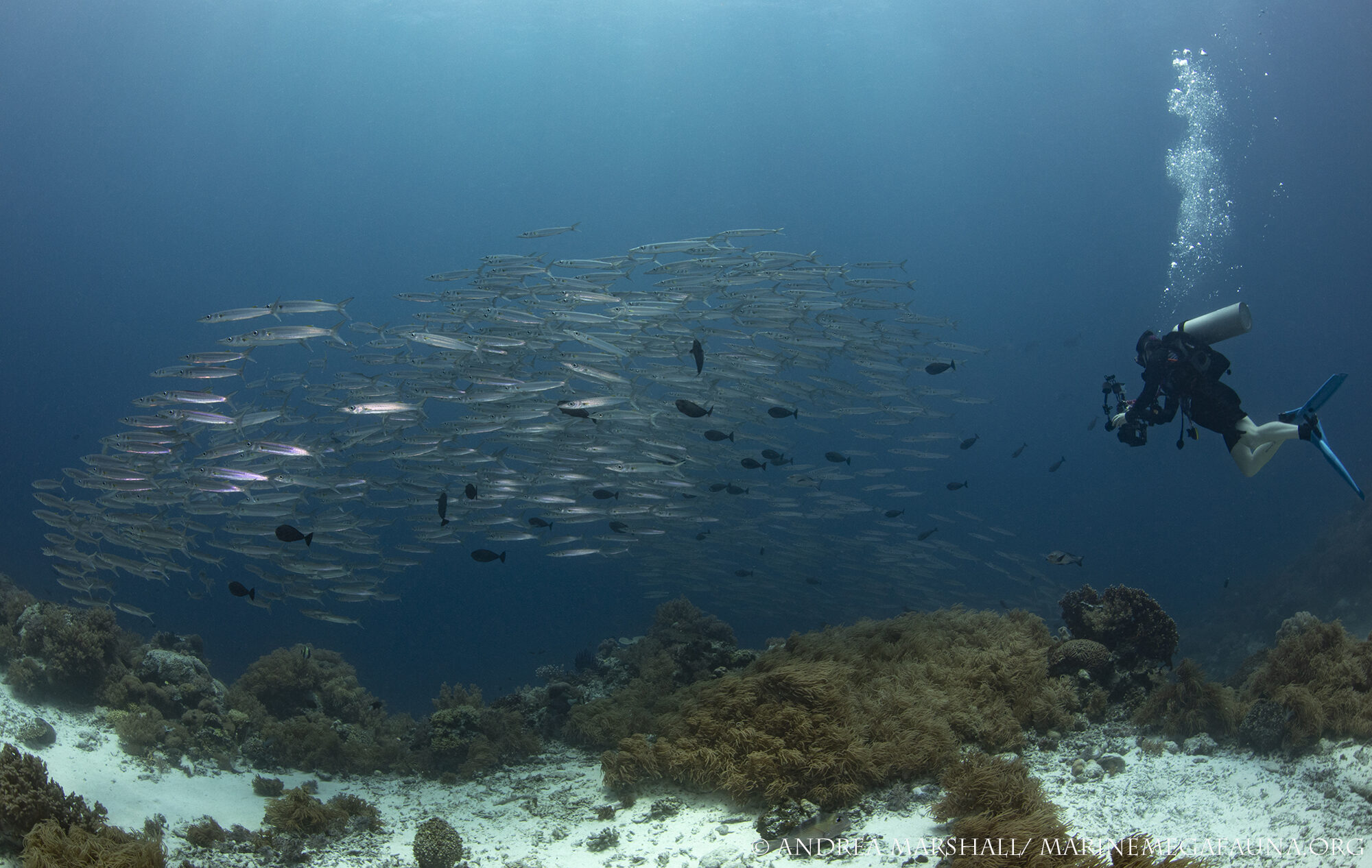
How can we better adopt natures patterns in the way we work?
Can we draw out some ecological perspectives from a better understanding of how Nature thinks? Is it possible to use a hybrid of human patterns, human technology and traditional strategies to form a kind of augmented ecology - using the sum of all available techniques to try to do better: to engage the world in ways that have fewer unexpected side-effects and that harness freely available energy resources and distribute them more effectively?
I do want to take a moment to remark that I'm somewhat unsure if humans can adapt geological perspectives. We are narrative machines, with deeply felt emotions, and these are subjects that are somewhat alien, larger than our ability to understand. But I do think we should try to see if we can adapt any patterns to better have our affairs align with the natural world.
1. Work with not against
An ecological way of thinking appears to be more finding ways to work with powerful forces rather than work against them. This has also been part of the 'atoms to bits' thesis; that a bridge can be built with less material if it has actuators that allow it to dynamically respond to load pressures.
2. Understanding is not always possible
It’s been said that “things should be as simple as possible but no simpler” but in fact simplicity of natural systems can be beyond our ability to reason about, or to even find beautiful or delightful. Phenomena in the world can be complex beyond our ability to appreciate. Our behavior is ultimately informed by our aesthetics. Effectively we are surrounded by hyper objects. The reminder is that we tend to simplify, often over-simplify, systems we build to be human-comprehensible. What appears to be "beautiful" to us is often "simple". Eric Berlow speaks to this in his TED talk.
See: https://www.ted.com/talks/eric_berlow_simplifying_complexity and https://www.upress.umn.edu/book-division/books/hyperobjects .
An excellent example of where our sweet spot for the appreciation of complexity can be easily seen in Mozart. Many of his pieces sound delightfully complex to us - but would they sound complex to an alien mind? If you watch the video you can see the pieces are decomposed for the left hand and right hand. Would a piece composed for an octopus be equally as pleasing to us or would it just sound like a noisy cacophony?
See https://youtu.be/EYLk1kXDI_s .
We have limits but we cannot see those limits very well. There is a cognitive blind spot around complexity. We are stuck with our limited aesthetics around what we can manage (even with a hybrid of human/machine reasoning as we do now) and have to find ways to bridge the gap between human understanding and the true complexity of real systems.
Our agricultural systems are a good example of where we over-simplify. We need to be able to manage and understand the growth of crops - so we use pesticides to kill everything in a field, plant what we want and use fertilizers to “make stuff grow good”. We are missing opportunities to harness free energy resources because we simply never thought about finding ways to work more closely with what we saw as pests. Even nitrogen fixing becomes a chore with fields remaining fallow for a season to recover from our depredations. We occasionally even decide to try to kill all the pests and instead kill off millions of people instead [ https://en.wikipedia.org/wiki/Four_Pests_campaign ]. Even the simple act of digging rows to plant crops misses an awareness of the local microbial biome and its huge impacts on yields. Meanwhile native americans had huge food forests that were simply biased to favor human friendly delights.
See: https://en.wikipedia.org/wiki/Four_Pests_campaign .
3. Ecological Scale Design
A mantra that had felt valuable to me in the past was an idea of "human scale" design thinking. That we can and should build systems that are not just satisfying for us as humans, but that exercise us, that help bring out the traits in ourselves and others that we value the most.
This mantra is based on the William Churchill thesis that "we shape our buildings and afterwards our buildings shape us" (also attributed to Marshall McLuhan in the form of "We shape our tools and thereafter our tools shape us"). It's an observation that we can become "more human" if we create environments, software, and tools that encourage us to be prosocial, engaged, and active, as well as other traits that we value.
It's worth noting that there are many mantras that designers rally around such as "designing for human delight" or "maximizing revenue" or "for the fatherland". Cybernetics and Systems Theory (popular in the 60's and 70's) are also arguably design mantras as well - effectively measuring sticks to use to measure any project one is engaging on. Christopher Alexander was hugely popular with his Design Patterns work, and similar ideas also became a part of computer interface design.
But, this motif now feels obsolete to me in some respects. When witnessing the wonder of a reef ecosystem the pressure seems to instead to not become merely "more human" but "more animal" or more a part of something larger than merely being a good citizen, or fit, or healthy. Those feel like insufficient bars. A good starting point for example may be to have more non-human friends. If we only see each other as fellow humans we seem to be missing out on a conversation with a wider part of the world. In a sense our view is too narrow. How can we be good citizens of the planet if we are not actually viscerally and emotionally connected to the lives of entities other than ourselves?
I do think an ecological scale design motif may be better. We may need a design bible for how to design with nature not against nature. Effectively ecological thinking versus cybernetic thinking, or ecological versus economic thinking (and the associated perverse incentives there).
4. Adversarial Signaling
While diving I've been noticing that there is a lot of signaling and counter signaling. It's like an adversarial market where some fish are trying to kill other fish, but then there are also real opportunities, and there's a cloud of noise around what is real or not. In the BBC documentary (mentioned above) a grouper and an octopus find a way to communicate with each other to devise a strategy to work together to hunt for prey. Arguably each could ignore the other, but they are able to signal through the noise for their benefit.
See: https://www.theguardian.com/tv-and-radio/2017/nov/20/blue-planet-ii-what-have-we-learned-so-far .
Earlier that week I'd been watching a mimic octopus very carefully. Hugging a sandy floor, it had spread out flat; but then suddenly turned into a sole fish; undulating sideways, and then into a lionfish, and then suddenly turned black. It was dramatically changing its appearance in quite surprising ways; using a repertoire of other species as camouflage - shape shifting its physical configuration, color, texture and movement. It surprised and startled me; even though I as a human had a fairly keen ability to continue to track it through all its changes. I had also routinely seen octopus poking their heads out of corals; not exactly hiding but simply watching and observing - almost as if a relationship was possible if I could stay down long enough for it to develop.
I'd also routinely noticed the entire reef around me suddenly hide and then emerge as a single predator swept past - but very much a function of the precise distance and the precise velocity. A fast predator far away was ignored. A slower predator closely making any swift motion was suddenly cause for alarm by everybody within the sensory range of detection. Even if I moved too quickly myself I'd cause the entire reef around me to react; so I worked hard not to do that.
This isn't to mention that the entire reef and everything in it is painted, colored, and moving in a way that is often playing with and using color, obstacles, and position as a way to be visible or hide. There is also an incredibly rich soundscape, but I am unable to detect where sounds emit from.
The reef and everything in it is highly responsive. And I can't help but wonder if there isn't some kind of adversarial signaling marketplace - some costs are too expensive to fake - and others are probably used routinely. The information flowing in real time in a reef starts to look like advertising; a lot of noise with aggressive filtering attempts. In human systems we tend to have organized flows of information that we trust - we see advertising and public signaling as outside of our trusted channels. I don't know but I suspect that natural systems are not exactly like human systems - the public comms channel may be all there is; and animals may have highly refined bullshit detectors.
If there's a lesson here I think it would be that we should work to be able to deal with noise better; to find signal in noise - rather than working so hard on secure communications channels. Perhaps also I think we should examine incentive models for why agents create fake signals. A good example in our world is the arms race between advertisers and web developers - we could examine the incentives to spam people and try to reduce them rather than block them.
So much of this is limited by the brief time we can spend underwater. If we could spend more time lingering and allowing this world to fill our senses we might learn more.
5. Distributed
A commonly notable feature of ecologies is that no one entity seems to capture the whole system. There's a tendency for any single sufficiently large pile of tinder to burn down, or attract hyper-predators that quickly erode it.
We can philosophically design our systems to be similar; to avoid concentrations of power.
6. Participatory / Democratic / Fair
Ecosystems seem to foster participation; effectively entities are "voting" on outcomes with their behavior. Stakeholders appear to be present even if they don't always have equal votes. Effectively it is a kind of market place where entities place bets that outcomes will happen. The fairness comes from the ability to place a bet (that it will be cloudy tomorrow or that a predator will not emerge this evening). When stakeholders cannot place bets in a sense, when they are held hostage to other parties, they lose agency, becoming a client species.
7. Intimate
We romanticize people who live in a close relationship with the land around them. First peoples and even farmers. But it is still worth noting that there is a kind of sensitivity to the land that we are capable of developing when our lives depend on it. I do believe that this intimate awareness is a key trait for success in any system. Humans have a capacity to imagine themselves as something, imagine the outcomes of that thing, and use that understanding to better or more gracefully navigate a situation. We lose that ability vis a vis an ecosystem when we no longer intimately rely on it directly but instead have our relationship mediated through say a grocery store.
8. Aliquid
More tactically I note that we tend to demarcate everything in dollars, and that there's a high liquidity between currencies in general. But economics is a subset of ecology, if we’re only using one currency, and assuming everything is fungible in terms of that currency, we are over-simplifying. Nature seems to have many kinds of energetic storehouses of value, and they are aliquid. If we adopted that pattern, had thousands or even millions of bioregional currencies, for each community, each topic, each interest - and if it was harder for those currencies to become hyper-liquid, then it might keep local value in local communities for longer, and help protect them against ravages in other liquidity pools.
9. Seeing the whole
Mostly I was struck by seeing reef ecosystems in the large. Not just the organisms within them. The entire reef ecology was like an entity. It felt responsive, and the individuals felt like parts. A reef is like a person or a city.
Ecology in the western sense often has a hagiographic tone; it is a bit fantastical and put on a pedestal. Often centered around human needs, how to protect us, and is sacred for its value to us. But (as Derrick Jenson puts it) salmon deserve to live for their reasons not ours, because it is in their embodiment, not for their utility, or even their beauty. If they deserve to exist at all it isn't a function of them in relationship to us at least. Here we may leave an “ecological behavior” and recognize that as humans we have a “systems level” behavior and have to consciously choose to practice restraint. We should not seek to behave mindlessly like most animals, but instead behave like animals who can see the very deep implications of action.
The way we use the term ecology - such as say "the open source ecology" is very narrow, based around narrow legal foundations. We're not seeing "ecology" in the grand sweep of things; that is intersectional with everything, that is messy, and has unexpected side-effects.
We should not merely strive to visit these reef ecosystems, or other places where nature is on full display, and retreat clutching a few emeralds and golden doubloons, our learnings, our photographs. We need to more deeply appreciate how we are situated within the singular ecology of life as a whole and how deeply we need to work to participate in it. There is a whole, we will do better if we move in accord with it.
Applications of Ecological Thinking
The question now becomes if we have some nominal idea of an ecological understanding, and how ecological systems have performed better or at least differently from the comparatively brittle systems that we're engaged in, can we use this ecological mindset to reason better? To do a better job? We routinely put billions of dollars into companies that fail, or attempt to straighten rivers and are surprised when the knock-on effects dominate over the intended consequences.
For example, if Mark Zuckerberg had engaged in building Meta into a VR company, but with an ecological perspective would the outcomes be different? So far they have produced a bubble wrapped, closed ecosystem, incredibly banal milquetoast experience that doesn't let anybody participate in any meaningful way other than as a consumer. Even today, can we apply an ecological mindset to reason with Facebook before they dump a bunch more money into their VR department to help them understand how they could mitigate their incredibly excruciatingly bad decisions? For example could they open up their stack to third parties? Or delegate social policing outwards to be a community function of all participants rather than something performed by low paid workers in India?
Or, if we think about new frontiers, such as Space, which has yet to be captured by any one party, can we think about coordination problems of many nation states? We've divided Earth up into geographies that are disjointed and poorly managed. Space is a blue sky opportunity to think differently - we could choose to share Space in a healthier way. A Space-based ecology of largely human interests has many of the same emergent challenges as a natural system. For example we're already dealing with an increasingly human built world, and often one where artifacts we make are in fact not fit for human use, because the economic incentives are so misaligned. In a new frontier, is there an opportunity to change things to better align all participants?
Software development as a whole is another area where we can look to apply ecological practices. The software industry is more narrow than natural ecosystems but it is complex. We see examples of resilience, such as from the open source community, where applications may fail but tend not just "disappear" the way commercial products do. Still there is a deeper possibility here. We could start to think of all computers as simply part of the "space" of a single ecosystem and think about all applications as "agents" that move through those spaces. In this model agents could flow between machines wherever it is more efficient for their computation to run - and this could be a fresher interpretation of how we think about computing as a whole. This topic is in fact something I’m exploring separately at https://orbital.foundation .
Emerging Gestalts
Nature can be worshiped in a kind of sideways glance as in Shintoism or Balinese Hinduism, but merely worship isn't exactly what I'm looking for. It isn't merely a case of admiring the mystery of nature and being humbled by her power, nor even acknowledging that the world is beyond our individual comprehension. We only need to be in nature, to bear witness to nature, to know that. Part of what we need to appreciate is that we tend to over-simplify that which we do not understand; and it is more that we need to leave room for the unknown: we need to specifically set aside a lot more territory of the unknown, the under-utilized, the outside - whatever it is - than we do.
I am left with the feeling that we pursue misaligned shorter-term incentives. There are still lessons to be learned by better observing Nature. By this I mean looking to work with forces that challenge us rather than merely preserve the status quo, allowing ourselves to be flexible, to adapt and change more, trying harder to observe the complexity of systems around us, perhaps thinking on longer time lines, trying to avoid looking only at economic bottom lines and to imagine possible side effects more.
We are leaving the age of human labor and human cognition, and entering a machine age. We may soon no longer be the most intelligent species on the planet, nor fastest nor most able. We already fail to produce durable long term outcomes, even our machines will struggle. Philosophically we need to step away from the idea of simple ideas, silver bullets and quick fixes, and work harder to see the real outcomes for the real systems and a wider set of stakeholders.
We have to put aside our aesthetics, be messier, use everything all at once, try all ideas in parallel. Study natural systems for what we can discern, work with nature, use technology to support natural systems. Part of this is making natural systems more visible to us, augmenting our perception. In a sense creating an augmented ecology that is a mixture of human, machine and nature. One good place to start is to have more non-human friends, and to visit some of these systems to see what true complexity and true resilience is like.
NOTES
- https://www.goodreads.com/en/book/show/401670
- http://www.naturespeace.org/edricketts51steinbeck.htm
- https://www.biology-design.com/
- All watched over by machines of love and grace
- Braiding Sweetgrass
- Sounds of Life - Kathy Bakker
- Song of the Cell
- https://www.planktoscope.org/
- https://www.routledge.com/Sacred-Ecology/Berkes/p/book/9781138071490
- Rushkoffs books have some good points also
- Add some comments on permaculture farming - or working with systems rather than dominating them